
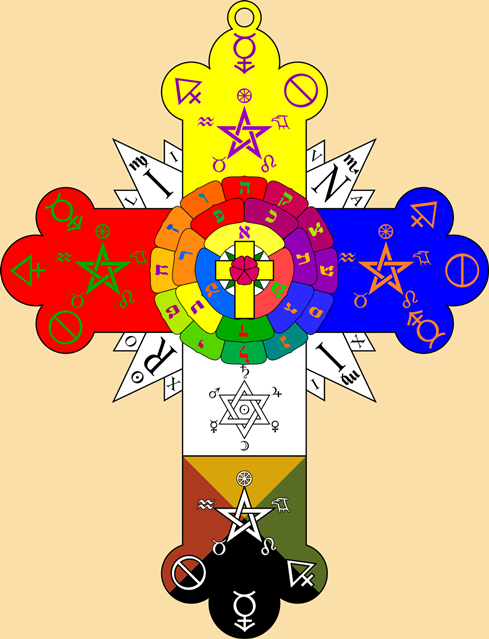
Definition: The “Rose Cross” is a symbolic emblem consisting of a cross with a rose at its center. It represents the union of opposites, most commonly spirit and matter, and serves as a visual synthesis of metaphysical, psychological, and cosmological ideas. It is used in various esoteric traditions as a symbolic map of reality, consciousness,… Continue reading Rose Cross
Category: Number
Three (3)
Definition: The number “3” is the third natural number following “2” and preceding “4.” It represents a quantity of three units or objects. Etymology: The etymology of the number “3” traces back to Proto-Indo-European roots. The word “three” in English and its equivalents in many other languages can be traced back to the Proto-Indo-European root… Continue reading Three (3)
Two (2)
Definition: The number “2” is the second natural number and the smallest prime number. It represents a quantity of two or a pair. Etymology: The etymology of the number “2” traces back to Proto-Indo-European roots. The word “two” in English and its equivalents in many other languages can be traced back to the Proto-Indo-European root… Continue reading Two (2)
One (1)
Definition: The number “1” is the first and smallest natural number. It represents a unit, a single entity, or a quantity of one. In arithmetic, 1 serves as the multiplicative identity, meaning that any number multiplied by 1 remains unchanged. Etymology: The etymology of the number “1” traces back to Proto-Indo-European roots. The word “one”… Continue reading One (1)
Zero (0)
Definition: The number “0,” often referred to as “zero,” is a mathematical symbol that represents the absence of quantity or value. Etymology: The etymology of the number “0” traces back to the Sanskrit word “śūnya,” meaning “empty” or “void.” This concept of zero as an empty placeholder was later transmitted to Arabic as “sifr,” which… Continue reading Zero (0)